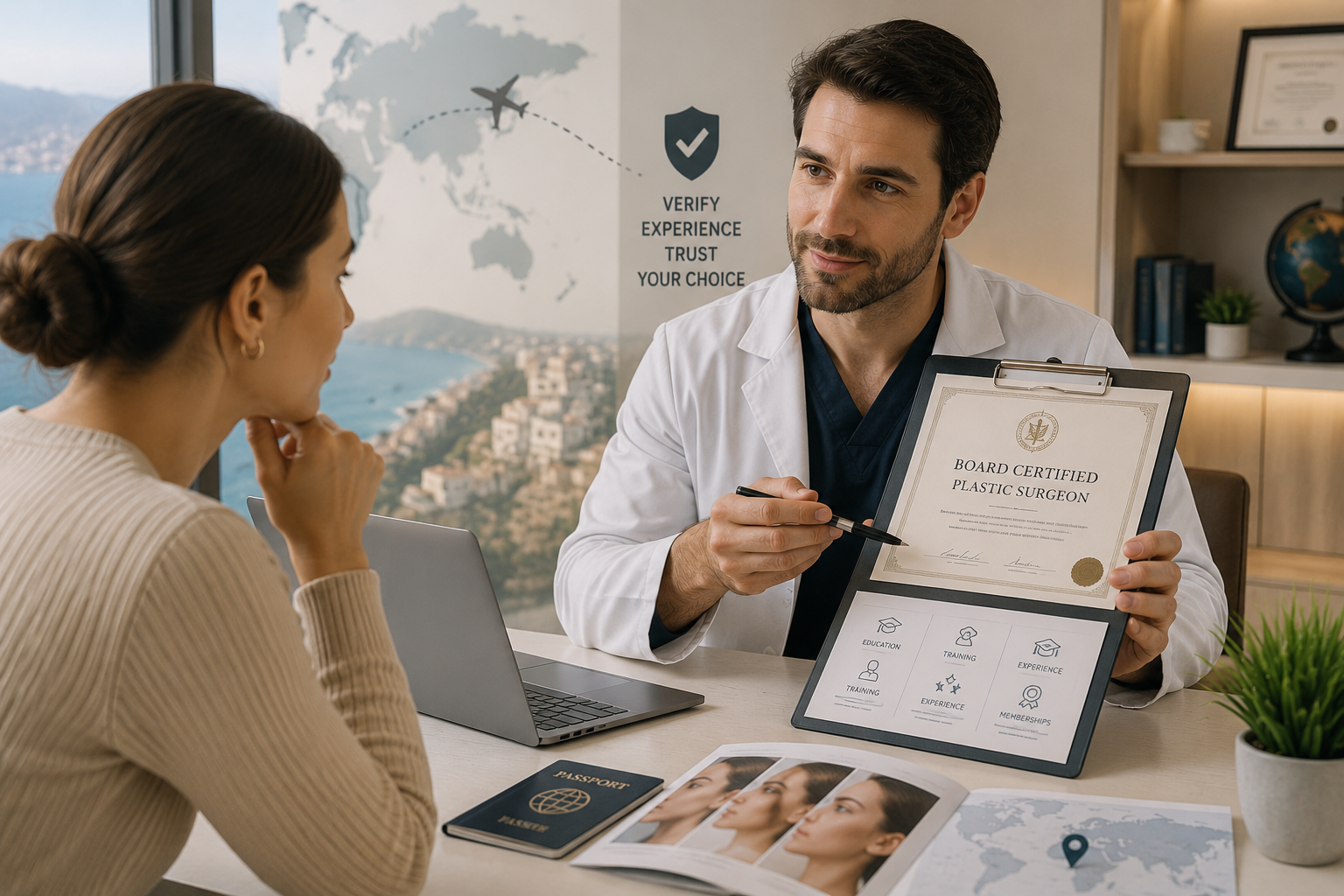
QUICK TAKE: HOW TO VERIFY SURGEON CREDENTIALS ABROAD
To verify a surgeon's credentials before cosmetic surgery abroad, you confirm each credential directly with the issuing body, not the clinic's own marketing page. The stakes are real. A 7-year retrospective in Aesthetic Surgery Journal Open Forum found plastic surgery tourism drives expensive, resource-heavy complications, and Slovacek et al. report complication rates as high as 74% in some cohorts.
Core Surgeon Check: Query national databases directly; never rely solely on a clinic's marketing materials.
Facility Licensing: Verify Joint Commission International (JCI) status alongside national hospital licensing.
Surgical Setting Safety: Ensure major procedures are routed to accredited hospitals, not standalone office suites.
Verified Registries: Cross-check the ISAPS directory, Korean KSPRS, Royal College of Thailand, or Malaysia's NSR.
Why verifying a surgeon's credentials before cosmetic surgery abroad matters
Verifying a surgeon's credentials before cosmetic surgery abroad matters because the complications, when they happen, are common enough and expensive enough to justify the effort. A seven-year retrospective by Hery et al. found that plastic surgery tourism strained hospital resources and produced costly morbidities in patients seen after they returned home. Slovacek et al. reported complication rates reaching 74% in some cohorts. Across the literature, including Alkaelani et al. and McAuliffe et al., infection, wound dehiscence, and seroma appear as the most frequent problems.
The failure mode this guide prevents most directly is ghost surgery, where the surgeon who appears in a clinic's marketing is not the one who operates on you. A polished bio and a familiar logo tell you nothing about who holds the scalpel.
The NHS advises patients to confirm the surgeon and plan for complications before booking. Ask these questions before you commit, not after something goes wrong.
Verify the surgeon, not the clinic's claim about the surgeon.
A clinic homepage showing a surgeon's photo and a "board-certified" line tells you nothing until you find that surgeon's name in an independent registry. Every one of Le Medica's three destinations maintains a public body that lists genuinely certified specialists, and each one lets you confirm a name yourself before you send a deposit. Verify the surgeon by searching these registries directly, not by trusting the bio the clinic wrote about itself.
The title alone proves less than most patients assume. In South Korea, "board-certified plastic surgeon" is a legally protected title that requires four years of full-time residency in plastic and reconstructive surgery at a university hospital plus a national board exam. A general practitioner or dermatologist can legally perform cosmetic procedures without any of that training, and many do. The word on the page is not the credential. The registry entry is.
Use the tables below to confirm the operating surgeon in each destination.
Country | Key Credential to Verify | How to Check (Official Registries) |
South Korea | Plastic Surgery Board Certification (not GP license) | Search the Korean Society of Plastic and Reconstructive Surgeons and cross-check international status on The Aesthetic Society. |
Thailand | Thai Board of Plastic Surgery Certification | Confirm active board status via the Royal College of Surgeons of Thailand |
Malaysia | NSR Plastic Surgery Specialist Registration | Search Malaysian Medical Council & confirm specialist status on the National Specialist Register. |
International | Active ISAPS Directory Membership | Search the ISAPS Find a Surgeon tool. |
Verify the hospital or clinic's accreditation
Confirm the facility directly with the body that accredited it, because a logo on a homepage proves nothing until it appears in the issuer's own database. Each destination has both an international accreditation you can check and a national registry that tells you the hospital is legally licensed to operate. Verify both, since one answers the quality question and the other answers the legality question.
Thailand
International Accreditation: JCI accreditation
National Oversight: HA-Thailand & Ministry of Public Health (MOPH) licensing
How to Verify: Search the official JCI accredited-organizations finder by hospital name, then confirm a current HA-Thailand certification.
South Korea
International Accreditation: JCI accreditation
National Oversight: MOHW (Ministry of Health and Welfare) & KOIHA certifications
How to Verify: Search the government's official Medical Korea registry to confirm the clinic is registered to treat foreign patients.
Malaysia
International Accreditation: JCI accreditation
National Oversight: MSQH (Malaysian Society for Quality in Health)
How to Verify: Search the active MSQH registry to confirm the facility holds current, unexpired clinical accreditation.
Read JCI accreditation as a meaningful plus, not a guarantee of a safe outcome. JCI measures a hospital's systems for infection control, patient identification, medication safety, and emergency readiness. It does not certify the individual surgeon operating on you, and it does not follow every treatment room inside the building. A JCI-accredited hospital can still house an office-based cosmetic suite that runs to a lower standard than its main operating theaters.
The same nuance applies across all three countries. HA-Thailand and MSQH assess the institution, and neither one vouches for the specific surgeon or the specific room where your procedure happens. National licensing tells you the hospital is legally permitted to operate, which is the floor you should never go below. Treat any facility that cannot show up in its own national registry as unverified, regardless of how polished its marketing appears. When you find the same hospital named in both the international accreditation database and the national registry, you have confirmed the facility itself, and the next step is the surgical setting.
Verify the surgical setting is equipped for the procedure you're having.
An accredited hospital name tells you the institution passed a facility review. It does not tell you the specific room where your surgery happens carries the anesthesia and emergency support your procedure demands. A hospital can hold JCI accreditation and still route a body-contouring case into an office-based suite that lacks ICU-level backup. You verify the setting by asking about the room, not the letterhead.
Three answers separate a properly equipped setting from a risky one. First, confirm the facility has ICU-ready anesthesia coverage and an emergency plan that transfers you to intensive care without delay. Second, confirm a dedicated anesthesiologist manages your airway and monitoring throughout, rather than the operating surgeon splitting attention between the incision and your vital signs. Third, treat major surgery in a standalone office suite as the clearest danger sign. An abdominoplasty or breast augmentation belongs in a hospital-grade operating room, not a converted clinic space.
Setting matters most for exactly the procedures patients travel for. The Hery et al. seven-year retrospective at OhioHealth Riverside Methodist Hospital found that seromas and infections were the most common complications among medical-tourism patients seen post-operatively, and abdominoplasty, liposuction, breast augmentation, and Brazilian butt lift were the most common procedures involved (Hery et al., Aesthetic Surgery Journal Open Forum, 2023). Those procedures create large surgical fields, longer anesthesia times, and higher fluid shifts, which is precisely why the room's monitoring and rescue capacity carries so much weight.
Ask where your surgery will physically take place, request the exact operating suite and its anesthesia setup, and confirm the answer in writing. A practice equipped for the procedure states this plainly. Hesitation or a vague answer about the room is itself the signal to slow down.
The questions to ask on your consultation call
Before you book, run this two-minute test on your consultation call. A legitimate practice answers every one of these questions plainly and without hesitation. Vague answers, deflection, or a promise to "explain everything when you arrive" tell you more than any brochure. Ask these word for word.
"What is the full legal name of the surgeon who will perform my operation, and what is their official specialty?"
"Where exactly will my surgery happen? Please give me the full name of the hospital or clinic and its address."
"Who is my anesthesiologist, and what monitoring will be in place during and after the procedure?"
"Is that anesthesiologist a separate, dedicated doctor, or does the operating surgeon also handle anesthesia?"
"What is your specific plan if a complication happens during surgery or in the first 48 hours after?"
"Can you send me the surgeon's credentials and the facility's accreditation certificate in writing before I fly?"
The last question separates a confident practice from a cautious one. A clinic that has run its own verification hands you documents without friction, because it already has them on file. If the person on the call cannot name your operating surgeon or your anesthesiologist, treat that as a reason to keep looking, not a detail to sort out later. Le Medica supplies these answers in your itemized quote before you commit to travel, as part of how the process works end to end.
Red Flag Signal | What It Means | Recommended Action |
Clinic won't name surgeon in writing | Risk of "ghost surgery" by an unlisted doctor. | Do not pay deposit until full legal name is confirmed in writing and verified in national registry. |
No facility accreditation on file | Missing active JCI, HA-Thailand, or MSQH license. | Search the accreditation body's official directory directly. Do not book if missing. |
Major surgery in office suite | Lacks ICU-ready anesthesia & rescue protocol. | Confirm surgery takes place in a hospital-grade OR with a dedicated anesthesiologist. |
Unverifiable "Board-Certified" claim | Title used as a marketing buzzword. | Verify board registration directly with the official national medical board. |
Red Flag: Before & after photos that look flawless across every patient
What It Means: Possible stock photos, heavily edited images, or work stolen from other surgeons' portfolios.
What To Do: Ask to see unedited, high-resolution case photos during your direct consultation and confirm the surgeon personally performed those exact cases.
Pre-op nerves, worry about pain, and anxiety about bruising or swelling are normal. They tell you nothing about whether the surgeon or facility is legitimate. Do not treat ordinary fear as a reason to cancel, and do not let a clinic dismiss a genuine verification failure by calling it nerves. The two are separate, and only the failures on the table above should change your decision.
How Le Medica's vetting differs from a listing directory
Every step in this guide describes work you can do yourself. A directory hands you a surgeon's name and a clinic bio, then leaves the rest to you. You confirm the board registration in Korea, cross-check the Malaysian Medical Council entry, search the JCI-accredited organization finder for Thailand, and ask the office suite whether an anesthesiologist covers the case. You verify from zero, one body at a time, right at the point when you feel least equipped to judge.
Le Medica runs that checklist before a surgeon or hospital appears in front of you. Le Medica confirms each surgeon's board certification through the issuing registry, verifies the facility's accreditation directly with JCI, HA-Thailand, or MSQH depending on the country, and publishes those credentials alongside the listing rather than a logo you have to trust. Le Medica's quotes itemize what you are paying for, which removes the guesswork a single lump-sum figure creates.
That difference changes your role. Instead of validating strangers under time pressure, you review verification someone has already completed and documented. You still ask the consultation questions and read the red-flag table, because informed patients make better decisions. The groundwork is already on the table.
Le Medica's value continues past that first check. Coordination between your overseas surgeon and your local care team carries into what recovery actually looks like, so the continuity you need after surgery does not depend on the same verification effort a directory left entirely to you.
Frequently asked questions
Is JCI accreditation enough on its own, or just a plus? JCI accreditation confirms a hospital meets an international standard for safety and quality, which makes it a meaningful signal. It does not vouch for the individual surgeon or the specific suite where your procedure happens, so treat it as one check among several rather than proof on its own. Pair it with surgeon-level and setting-level verification.
How do I check if a surgeon is really board-certified? Confirm the surgeon directly with the issuing body rather than trusting a title on a bio. In the US, the American Board of Plastic Surgery runs a public lookup, and the ISAPS "Find a Surgeon" tool verifies active international members across Korea, Thailand, and Malaysia.
What does "international member" of ISAPS actually mean? ISAPS grants international membership only to surgeons who already hold recognized plastic surgery board certification in their own country and pass the society's screening. A verified ISAPS listing confirms the surgeon met that bar, which is why the directory works as an independent cross-check against a clinic's own claims.
Is an office-based clinic ever safe for a minor procedure? Yes, small procedures under local anesthesia can be appropriate in a licensed office setting. The danger appears when a clinic runs major surgery in an office suite without ICU-ready anesthesia coverage. Match the setting to the procedure's actual risk, not to the clinic's convenience.
How do I verify the anesthesiologist? Ask for the anesthesiologist's name and confirm a dedicated anesthesiologist manages your case rather than the operating surgeon doubling as one. In Malaysia, you can check specialist status on the National Specialist Register, and in Korea and Thailand the national board registries confirm the same.
What if a clinic won't name the operating surgeon? Treat a refusal to name the operating surgeon as the clearest ghost-surgery warning, where the surgeon shown in marketing differs from the one who actually operates. A legitimate practice names the surgeon in writing before you commit. Walk away if they cannot.
Does government licensing matter separately from JCI, HA-Thailand, or MSQH? Yes. Government licensing through bodies like Thailand's Ministry of Public Health confirms the hospital is legally permitted to operate, while JCI, HA-Thailand, and MSQH assess quality standards. Confirm both.
How do I cross-check a Korean, Thai, or Malaysian surgeon from outside the country? Use each country's registry from your laptop before booking. Search the Korean Society of Plastic and Reconstructive Surgeons in English, the Thai Board of Plastic Surgery, or the Malaysian Medical Council, then cross-check the ISAPS directory.
What documentation should arrive before I fly out? You should receive the named surgeon, the exact hospital, an itemized quote, and a written complication contingency plan. The NHS cosmetic surgery abroad page recommends confirming these before travel.
How do itemized quotes relate to safety? An itemized quote lists the surgeon's fee, facility fee, anesthesia, and follow-up separately, which forces the clinic to name who does what. A single lump-sum figure hides exactly the details verification depends on, which is also why all-inclusive package terms are worth reading line by line rather than taking at face value.
Does board certification have to be legally required to matter? No. Certification is a voluntary credential in several systems, which is precisely why direct verification beats trusting a title. A surgeon can call themselves certified without a registry trail to prove it.
Is there a single safest country for cosmetic surgery abroad? No country is uniformly safest. Complication rates depend on the surgeon, the hospital, and the setting rather than the destination, with reported rates reaching as high as 74% in some cohorts. Run the verification steps in this guide regardless of where you go, whether comparing rhinoplasty in South Korea or a tummy tuck abroad.
Book a consultation with a team that has already done the verification.
Every check in this guide takes time, and Le Medica has already run each one before a surgeon or hospital reaches its network. Board certification, facility accreditation, and setting-level safety are confirmed and published upfront, alongside an itemized quote that names exactly what covers the surgeon, the facility, and aftercare. Browse verified surgeons and accredited hospitals across South Korea, Thailand, and Malaysia, or see how the process works from first consultation to recovery. To ask about a specific procedure or destination, get in touch or read more about Le Medica.
References
Hery D, et al. Plastic Surgery Tourism: Complications, Costs, and Contributing Factors. Aesthetic Surgery Journal Open Forum. Available from: https://pmc.ncbi.nlm.nih.gov/articles/PMC10783483/
Slovacek C, et al. Who Owns the Complications? A Call for Accountability in Cosmetic Tourism. Available from: https://pmc.ncbi.nlm.nih.gov/articles/PMC12803711/
Alkaelani MT, et al. Complications of Medical Tourism in Aesthetic Surgery. PubMed. Available from: https://pubmed.ncbi.nlm.nih.gov/37962261/
McAuliffe PB, et al. Complications of Aesthetic Surgical Tourism Treated in the USA. PubMed. Available from: https://pubmed.ncbi.nlm.nih.gov/36315261/
NHS. Cosmetic surgery abroad. Available from: https://www.nhs.uk/tests-and-treatments/cosmetic-procedures/advice/cosmetic-surgery-abroad/
Joint Commission International. Find Accredited Organizations. Available from: https://www.jointcommission.org/en/about-us/recognizing-excellence/find-accredited-international-organizations
American Board of Plastic Surgery. Verify a Surgeon. Available from: https://www.abplasticsurgery.org/public/
International Society of Aesthetic Plastic Surgery (ISAPS). Find a Surgeon. Available from: https://www.isaps.org/discover/patients-home/choosing-your-surgeon/